
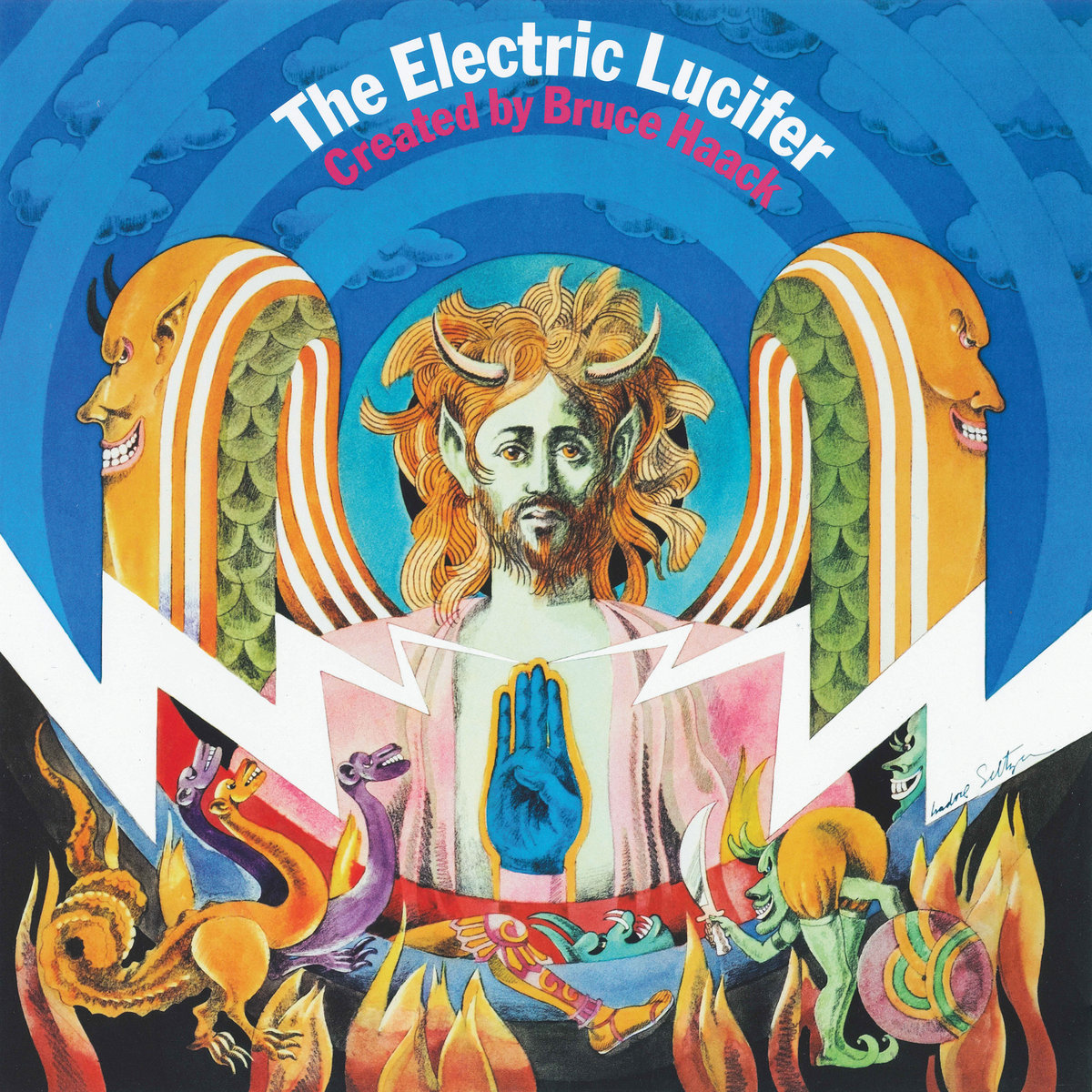
Artist: Bruce Haack | Album: The Electric Lucifer | Genre: Progressive electronic, Experimental rock | Year: 1970
From: Alberta, Canada | Label: Columbia
For fans of: The United States of America, The Residents, Cluster
The Electric Lucifer is the kind of crazy, oddball shit that I really love discovering and then sharing. I’ve known about this record for a while, and it is pretty wild. Bruce Haack (pronounced like “hack”) was a Canadian musician who started off his career dabbling in a lot of different styles. He briefly studied at Juliaard, and he also worked in theater, pop, and Ukrainian folk music throughout his early life. As synthesizers became more widely available, he began dabbling in proto-electronic music, and if his poorly-written and shoddily-sourced Wikipedia article is to be believed, he achieved some degree of notoriety.
Starting in the 1960s, Haack began releasing children’s music. But it was really weird children’s music, full of strange synth effects and hypnotic rhythms. Just take a listen to 1968’s The Way-Out Record for Children. So, while there may have been a thematic shift in Haack’s music, he was always dabbling in electronic experiments. The jump from his “children’s music” to The Electric Lucifer wasn’t as big as one might expect. The lyrics are markedly more serious, however, featuring a very strong anti-war message.
Bouncing, warbling synthesizers and heavily-processed vocals kick the record off on “Electric to Me Turn”. The mood feels almost celebratory, like some sort of invocation, especially with some scat singing that could pass for a synth solo. “The Word” is a brief bit of narration over groaning effects that set up the plot of the record.
“Cherubic Hymn” feels much darker. There’s a sense of despondency and mourning, and the vocals draw heavily from late ‘60s psychedelic pop. Haack twists bizarre squeals and hisses from his keyboards, evoking air raid sirens at points.
“Program Me” is methodical and hypnotic. Dashes of Near Eastern music crop up. The vocals are strong and feel nearly liturgical. This piece also features some of Haack’s most interesting playing. An organ-like synthesizer buzzes throughout this song, and atypical, jangly guitar noodling keeps the atmosphere always-askew. That lush soundscape gets stripped back to something harsh, austere, and haunting in the opening moments of “War”. Rapid, Baroque synth passages flutter by, only to be harshly cut off, and the same thing occurs with some music that would be right at home in a circus. The song’s second half features squealing, atonal synths, which quite effectively create a sense of unease.
“National Anthem to the Moon” is woozy and dreamy with a call-and-response verse, and “Chant of the Unborn” is an upbeat instrumental.
Side two of the record opens with “Invocation”. This is one of the more rock-influenced cuts and reminds me of certain late ‘60s art rock acts, like The Velvet Underground. There are some lovely synth flourishes between the verses, and the electronic percussion is especially interesting. “Angel Child” is another short piece, this one focusing on a repeated vocal motif.
“Word Game” bears certain similarities to early electronic krautrock acts. The instrumental backing chugs along as synths lines stutter and swirl over the top. The vocals are processed and feature Haack saying words, spelling them, and shifting to similar words.
“Song of the Death Machine” sounds the most like children’s music, with a nearly fairy tale-like quality. This is probably my least-favorite song on the album, but it’s not bad. Had this been a 1-minute interlude, I probably would have been fine with it.
The longest song on the album is “Super Nova”. Trilling synths echo, and some of those earlier Near Eastern touches reemerge here. The whispered vocals are a bit distracting, but the overall composition is strong enough, I don’t mind. This piece bears some similarities to some of the more electronic passages on Aphrodite’s Child’s 666. The closing “Requiem” is tense and urgent, again drawing on the sounds of psychedelic pop and rock. Had Syd Barrett played a synthesizer instead of a guitar, I could have envisioned him recording this.
Bruce Haack continued to release music throughout the 1970s, as well as one more adult album in 1981. Since his death in 1988, a handful of archival releases have come out, including Electric Lucifer: Book 2 and the wonderfully-titled Haackula. These are both decent and somewhat similar to this album, if a bit more minimal in their sound.
The Electric Lucifer is a highly original record. It is weird as hell, full of sounds that would be considered left-field even today. But at the same time, Bruce Haack’s madcap album had a sense of where certain winds were blowing, as its influence can be heard in many electronic and krautrock artists.
Score: 94/100
 The Elite Extremophile