
January is always a weird time of year for me to write. I’m done with my 2025 best-of lists, and I do have some music to cover, but not a ton. Or, at least, I need to spend some more time combing Bandcamp to find new stuff to cover and build up a backlog. The Elite Extremophile isn’t all recent album reviews and lists of blurbs, though. I do have two other (very) occasional columns: Deep Dive and Lesser-Known Gems.
On the Deep Dive front, sorry for not putting one out last year. I got about a third of the way through writing one for Camel, but then I kinda lost motivation. I enjoy Camel; I just find them weirdly hard to write about. I think I may set that one aside and do ELP or Kate Bush or something.
On the Lesser-Known Gems front, January offers a great opportunity for that. I can pound out 3-4 LKG columns in an afternoon or two, leaving me with the rest of January to discover and write about more-current releases.
So, without further ado, welcome to Lesser-Known January. Or, alternatively, Lesser-Known Gem-uary. Let me know which name you prefer.
Releases:
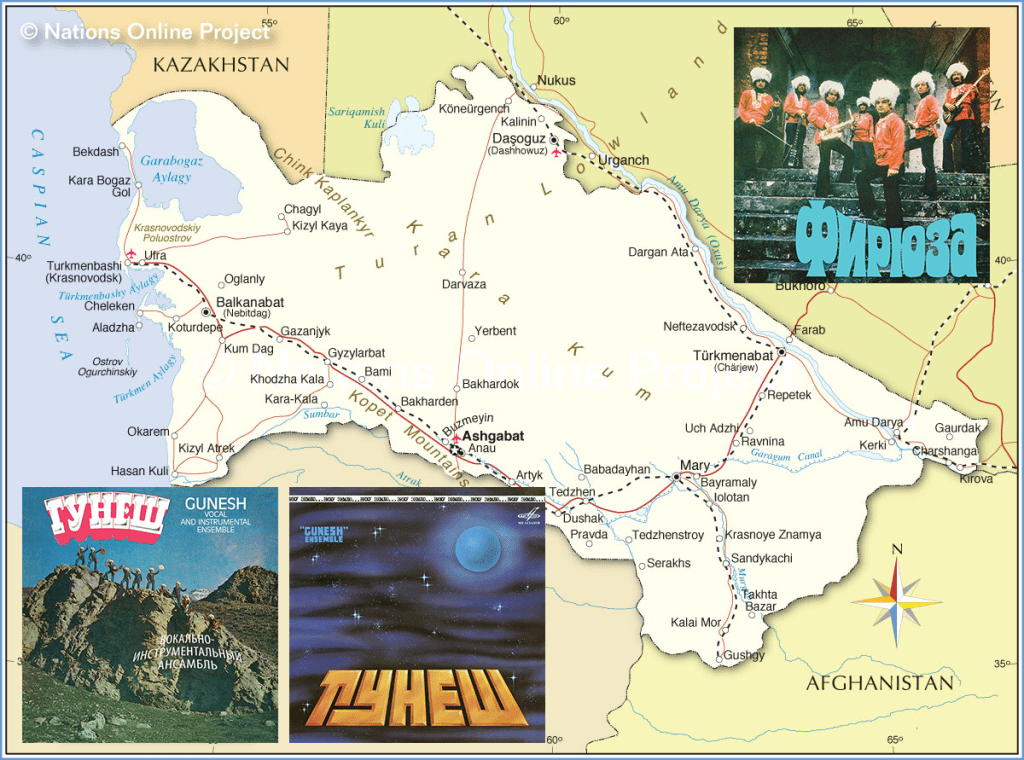
Фирюза – Фирюза (Firyuza – Firyuza), 1979
Гунеш – Гунеш (Gunesh – Gunesh), 1980
Гунеш – Вижу Землю (Gunesh – Vizhu Zemlyu), 1984
From: Ashgabat, Turkmen SSR (modern-day Turkmenistan) | Label: Мелодия (Melodiya)
For fans of: Return to Forever, Mahavishnu Orchestra
The first entry is a two-fer: Фирюза (Firyuza; Turkmen firýuza, meaning “turquoise”) and Гунеш (Gunesh; Turkmen güneş, meaning “sun”). Both bands originated from Ashgabat in Soviet Turkmenistan in the 1970s, and there was a bit of personnel overlap between the two acts.
I heavily relied on Russian Wikipedia being run through Google Translate to fill in the bands’ biographical details. I know a bit of Russian, but mostly just enough to (rather fluently) explain that I don’t speak good Russian. I certainly don’t know enough to read multiple Wikipedia articles about jazz groups. And reading what’s been translated, Russian Wikipedia seems to have a lot more editorializing than English Wikipedia, so I may need to take a few grains of salt with what I read.
Also, before I get into the reviews, I can’t talk about Turkmenistan without talking about Saparmurat Nyýazow, the Türkmenbaşy. He was leader of Turkmenistan from the dissolution of the USSR until his death in 2006. When talking about batshit insane dictators, he was among the batshittiest. He outlawed chewing gum and encouraged the Turkmen people to chew bones instead, claiming it would strengthen their teeth. He wrote a book, the Ruhnama, despite being functionally illiterate, and forced mosques to display alongside the Qur’an. Getting a driver’s license also required memorizing the book. He built an ice palace in the middle of the desert. He renamed the days of the week and the months of the year to references to the Ruhnama, and he changed the Turkmen word for “bread” to garbosoltan, his mother’s name. These are just some of the highlights of his insanity; he did so much more crazy stuff. He was also a brutal, oppressive tyrant, as was his equally-autocratic and only-marginally-less-wacky successor, Gurbanguly Berdimuhamedow. The current president of Turkmenistan, Serdar Berdimuhamedov, so far seems to be your run-of-the-mill autocrat.
Getting back to the music, Gunesh was the first of these bands to form. The band was started by vocalist Murad Sadykov in early 1970, and they began by doing vocal jazz and traditional Turkmen songs. By the late 1970s, the band had expanded to a full ensemble, and their songwriting had taken on a forward-thinking and complex style.
While Gunesh performed extensively, Firyuza was the first to record an album. Led by ex-Gunesh keyboardist Dmitry Sablin, Firyuza cut their self-titled album in 1979. In addition to mixing rock and jazz, they also heavily incorporated local Turkmen elements.
The album opens with gentle violin, flute, and piano on “Ашхабад” (“Ashgabat”). After an extended introduction, the song jumps into a jittery and anxious passage. Guitar skitters and stutters in the background as violin takes the lead. The mood fluidly shifts between high-energy and slow and dreamy. The drumming is especially impressive, and I love how high in the mix the bass is. Solos are powerful and emotive.
At nearly 10 minutes, “Край Родной” (Kray Rodnoy, “Native Land”) is the longest song on any of the albums covered here. Mouth harp, violin, and natural sound effects evoke a lonely scene. Woozy guitar and saxophone twist around each other, sometimes languidly and sometimes anxiously. The band demonstrates mastery of unusual chords and modes throughout. Reaching the song’s midpoint, there’s a sense of warmth and nostalgia, with synthesizer and heavily wahed guitar taking the lead.
“Чапыксуар” (“Chapyksuar”; I couldn’t find a translation for this one) has a rolling rhythm in its opening, with violin again taking the lead. Some funk elements sneak in here, especially in the keyboards and rhythm section. Bass is again a highlight, and the bandmembers all demonstrate their impeccable skills as soloists.
The album ends with “Диалог в Ауле” (“Dialog in the Village”). The mood is somewhat downcast in its opening, with guitar and keys providing a lush backing for violin. Things warm up in the second half, though. Guitars jangle and flute flutters by, adding some levity. The final 90 seconds feature an especially energetic, rousing passage.
Firyuza was a short-lived act. The band had been explicitly formed to participate in a Soviet music competition (The Sixth All-Union Competition of Variety Artists), in which they won first prize in the pop-instrumental category. After this competition, the band didn’t do anything else, as far as I can tell.
Gunesh released their self-titled debut record the following year. And though they are also a jazz-fusion band from Soviet Turkmenistan, their style was markedly different from Firyuza’s. Where Firyuza was fully instrumental and featured songs with long build-ups and a focus on atmosphere, Gunesh’s music had vocals and was often considerably more upbeat.
(As a note, for the sake of simplicity, I’ll be typing out Turkmen-language titles with the modern Latin-based orthography. Russian titles will still be in Cyrillic.)
1980’s Gunesh opens with “Jigi-Jigi”. (The copy I have tells me this translates to “девушка” (“little girl”) in Russian, but Google Translate is telling me it means “little by little.”) It features a fun and jazzy guitar lick, heavily supported by organ and a brass arrangement. The drumming is stellar, and the vocals do a great job lending this some strong pop sensibilities. The song’s instrumental midsection features ample Turkmen influence, especially in the percussion and during the saxophone solo.
“Tuni Derýa” (“Tuni River”) has an off-kilter guitar riff and tumbling bassline that gives the whole affair a charmingly disorienting feel. Many musical ideas cycle through on this piece, ranging from idyllic and folky to rather heavy and chaotic. Following this is the mellow “Akja Kepderi” (“White Dove”). This track is a slow ballad, supported primarily by organ and saxophone.
The instrumental “Восточный Сувенир” (“Oriental Souvenir”) features exciting passages punctuated with blaring brass, as well as anxious, skillful soloing.
“Keçpelek” (another incident of misaligned translations; Google says “fox”, but the Russian subtitle says “Баллада О Судьбе” (“Ballad of Fate”)) immediately evokes Gunesh’s Central Asian homeland. The dramatic, ululating vocals and Eastern-tinged guitar and organ are far from the musical traditions I normally cover. In its second half, the song picks up steam, culminating in an explosive, brass-fueled climax. “Ýalan” (“Deception”) is jumpy with a marching beat, and it hits my ear as having some roots in Russian music. The brass, in particular, sounds similar to a lot of Slavic folk music I’ve heard.
“Kone Guzer” (Google: “Go to the Coal Mine”, Russian: “У Старого Ручья” (By the Old Stream)) channels the longing vocals heard on “Keçpelek” but puts a more muscular backing behind it.
Gunesh ends with “Armanym Galdy” (Google: “I Have a Dream”, Russian: “Разлука” (“Parting”)), an upbeat and energetic piece full of nimble instrumental antics and the band’s distinctive Turkic flair.
At some point in the ensuing years, vocalist and founder Murad Sadykov left the band, meaning their next album would be mostly instrumental. 1984’s Вижу Землю (Vizhu Zemlyu, usually translated as “Looking at Earth”) is a somewhat spacier affair, but the band still puts on a dazzling display of extra-technical jazz-rock with Turkmen folk.
“Байконур” (the name the USSR’s (and now Russia’s) main launchpad for their space program, located in modern-day Kazakhstan), once it gets past its extended intro of radio chatter and sound effects, features a dazzling onslaught of keys and bass over tight drumming. The bass especially reminds me of Jannick Top’s work with Magma, with its aggression and how forward it is mixed. The second half of the song lightens things up, with saxophone drifting above jittery guitars, drums, and electric piano.
“Bu Derdy” (“This Problem”) has a similar, mathy opening, with synthesizer being the lead instrument here, but it soon dissolves into something slower and more astral. Touches of Pink Floyd and Relayer-era Yes are evident with the outer-space sounds and jazzy flourishes. Turkmen influences also crop up on this piece, especially in the flutework and vocals. Hajiriza Ezizov’s singing is powerful, soaring above the lush synthesizer textures.
“Восточный Экспресс” (“Oriental Express”) sounds somewhere between Yes and Return to Forever, with its energetic and multilayered keyboard parts, coupled with nimble and aggressive bass playing.
Funky clavinet and biting guitar give “Ритмы Кавказа” (“Rhythms of the Caucasus”) an earthier crunch than the preceding cuts. The song’s first minutes provide opportunities for guitar and violin to show off. In addition to the masterful soloing, the backing track can occasionally border on math rock with its sheer technicality. When things slow down, vocals briefly emerge again. The song’s final few minutes sees the band once more barrel headlong into speedy, complex shredding, and there is a fascinating percussion solo, with multiple types of drums layered atop one another.
“Ветер С Берегов Ганга” (“Wind from the Banks of the Ganges”) sees the band dip their toes into South Asian musical themes. Tabla and sitar are prominent, and it demonstrates some commendable musical curiosity, but the piece doesn’t really gel.
Вижу Землю closes with “Вьетнамские Фрески” (“Vietnamese Frescoes”). Opening with an extended, grainy sample of Vietnamese music, the band launches into their typical space-jazz but with some East Asian flourishes. This is an altogether more successful experiment than the preceding cut. The dazzling soloing calls to mind some of Frank Zappa’s early ‘70s output, and the synthesizers at times channel non-Magma zeuhl acts, like Eskaton.
Not long after releasing Вижу Землю, tensions between bandmembers and the Soviet Ministry of Culture led to bandleader Oleg Korolev being fired. Several other members of the band resigned in solidarity. With a reduced lineup (featuring several government-appointed musicians) the band limped onward for a few years, intermittently playing festivals. Gunesh officially dissolved in 1990.
In 2000, a re-formed Gunesh put out an album with Turkmen drummer Rishad Shafi, 45° в Тени (45 Degrees (Celsius) in a Shadow). It features a mix of new material and re-recorded older Gunesh material. I’m less nuts about this record and won’t go over it in detail. It draws heavily from funk music and features some pretty stellar playing. The main issues are that the synth tones sound horrifically dated, the production is lacking, the new material doesn’t feel particularly original, and there are too many drum solos. It’s not a bad album, but it doesn’t really tickle my fancy.
Scores:
Фирюза: 90/100
Гунеш: 88/100
Вижу Землю: 92/100
45° в тени: 64/100
 The Elite Extremophile
Amazing, thank you thank you!
Firyuza is available in higher quality (720p, upped in 2024). The sound is much cleaner, it may be from the CD reissue:https://www.youtube.com/watch?v=4h80cwqWqbs
LikeLike