

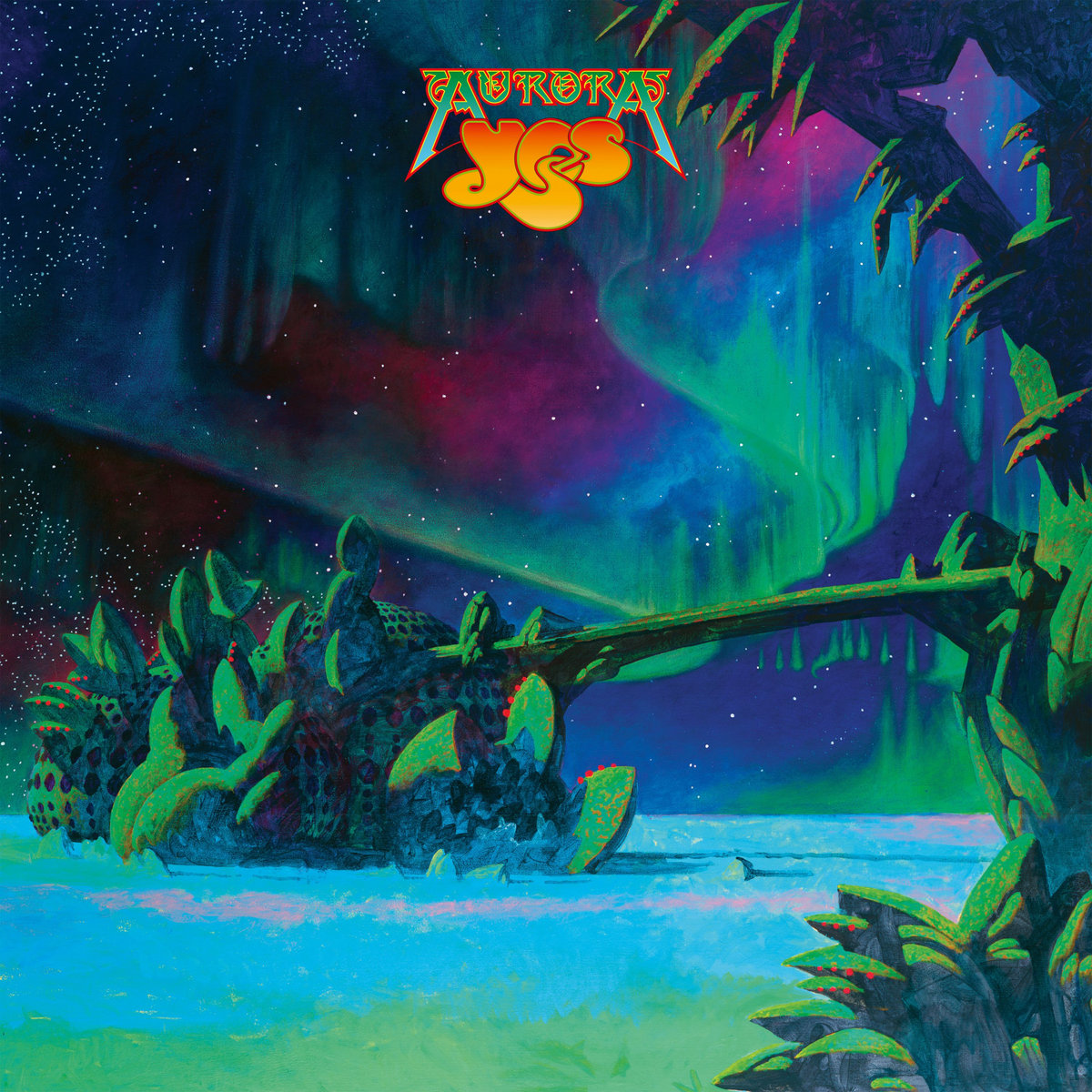
Band: Yes | Album: Aurora | Genre: Progressive rock | Year: 2026
From: London, UK | Label: InsideOut Music
Look, it’s a new Yes album. We all know who Yes are. We know what we’re signing up for. I had low expectations, despite Mirror to the Sky being pretty decent overall. Let’s just get to it.
Aurora opens on its title track, which was also its lead single. Sappy symphonic music kicks things off. They’re clearly trying to build a sense of grandiosity, but that is undercut by Steve Howe’s thin guitar tones, Geoff Downes’s horrific synth tones, and Jon Davison’s powerless singing. This song is pure schlock, with wimpy, syrupy production. I hated this song when I listened to it a couple months ago, and I still hate it now. This is the height of unnecessary music.
Now’s as good a time as any to kvetch about Jon Davison. Jon Davison’s vocals are so weak and willowy. He has consistently been the weakest link in this incarnation of yes, and that trend continues here. He is clearly beholden to the idea that he needs to sound as much like Jon Anderson as possible, and that forces him to only sing in falsetto. Jon Anderson does not sing falsetto. He simply has a very high voice. I saw him on tour about a year-and-a-half ago, and he still sounds amazing. He can put some real oomph into his performance, which Davison cannot. This restriction really only amplifies the overall fluffiness of Yes’s music. I’ve listened to some of Davison’s work with Glass Hammer, where his singing is more varied, and his performance with that band is much stronger, overall. When Trevor Horn took over vocals on Drama, he simply sang in his own voice, and that was great! I wish Davison would do the same.
Where was I? Oh, right, actually listening to this record. On the plus side, “Turnaround Situation” is very promising in its first 20 seconds or so. Then Geoff Downes demonstrates that he is stuck in 1986 when it comes to his synth tones, and I mean that derogatorily. This is a competent soft-rock song, and if I heard this in a church, I’d think it’s pretty good for a church band. But judging this as a Yes song, it’s not great. There are some decent instrumental ideas, but everything feels like it’s been sanded down. I can hear a better song hiding in there somewhere, but it’s evident to me that Yes has simply lost a step. And I will reiterate that I think much of this has to do with Jon Anderson not being in the band anymore. Not only is he a much better vocalist, but he’s also a great songwriter, as evinced on his last solo album.
“Love Lies Dreaming” starts off decently enough with a perfectly-fine keyboard-led instrumental passage. The verses are whatever, but there are some nice instrumental moments where Yes actually sounds like Yes, albeit weaker and wimpier.
Up next is the requisite suite, the 13-minute “Countermovement”. Howe’s got some nice soloing in the opening passage, including dashes of Middle Eastern scales, but the backing just feels so sanitized and neutered. I again need to ding the production. This passage sounds so small and compressed. Howe is clearly trying to evoke something majestic, but the song feels small and constrained. Steve Howe also takes lead vocals on the first verse, and he should probably just stay a guitarist. (And I’m saying that after I wrote the above rant about Jon Davison.)
I feel like I’m saying things like “weak” and “wimpy” an awful lot, but I can only abuse a thesaurus so much and still make my point. Sometimes you just need those simple, blunt words of Germanic origin to really drive a point home. And I raise this point because those really are the best words to describe the music here. The verses are uninterestingly soft and gutless. Even when Steve Howe busts out his mandolin and plays a line so close to “I’ve Seen All Good People” that if this were another band, they’d get sued for copyright infringement, that can’t do anything to save this piece.
Some of the internal transitions in “Countermovement” come off as nonsensical and jarring, like they’re just tossing ideas together. It’s a jumbled mess of harmonized vocals and unfocused riffs. The closing movement is a torpid and pointless solo.
The unnecessary (another word I’ll be overusing in this review) orchestra returns for “Ariadne”. It gives this song a pompous, bloated feel, and Steve Howe’s guitar tone is simply baffling. What do the strings add? Why try to make a song about the minotaur sound so fancy? The flat production handicaps some decent ideas in this song’s second half, and as with “Countermovement”, things continue to feel jumbled.
The opening riff of “All Hands on Deck” sounds like Yes trying to be Mountain or some other early ’70s bluesy hard rock band. It’s fine, if a bit out of character. But you know what? I’m just gonna take this moment to look on the bright side. It’s Yes actually trying something a hair different for once. The soloing is jangly and wiry, and it works pretty well. And it’s like Jon Davison read my note up above; he actually sings in his normal voice for (part of) this song! And as predicted, it’s a massive improvement. Howe’s voice still sounds like shit, but this is easily the best song on the album. It helps that it’s also only three minutes long, so it can’t drag on like some of the other pieces.
And all that goodwill is squandered with the fluffiest, bullshittiest opening on the record with “Outside the Box”. Moving past its introduction, there are some pretty good instrumental moments in this piece. Downes has some good synth tones for once, and the vocal arrangements are pretty fun. It gets a little repetitive by the end, but it’s solid, overall.
The final song on Aurora is “Emotional Intelligence”. It’s a bland, forgettable ballad.
But wait! This is InsideOut Music we’re talking about. Gotta slap on some superfluous “bonus tracks” to really milk consumers for all they’re worth with a two-CD release! 50 minutes of music totally needs to be spread across two discs.
The first of these bonus tracks is the stupidly-titled “Jambustin'”. And Jesus Christ, what the fuck is this shit? Twangy, hoedown guitar tones, sci-fi synths, and Davison’s half-assed vocals and lyrics all combine into a befuddling experience. And that’s all in the first minute. As the song progresses, there are some awful white-boy funk and surf rock touches, too. How can a four-minute song be this tonally confused?
The real final song is “Watching the River Roll”. This might be the best-sounding song on the album, insofar as the production is good, and I like Steve Howe’s guitar tone a lot. This isn’t offensively bad. It’s just a forgettable, slower song.
After hearing “Aurora” when it was released, this is about the experience I was expecting from this record. It’s bad. It’s boring. It’s unnecessary. It’s your typical 21st century Yes album. There are one-and-a-half songs I’d call good here, and a smattering of decent moments. Skip it. Or don’t. I’m not the boss of you.
Score: 41/100


that was a very negative review. I really don’t understand it. I think this is a great yes album.
LikeLike
I mean, I feel like I explained my reasoning pretty well. Everything feels anemic and fluffy, and the songwriting is often disjointed and purposeless.
At the end of the day, it comes down to folks’ personal taste.
LikeLike
Tee. I need to respond. Yes, you did explain your reasoning very well, it just took me awhile of listening to the Aurora album to see what you mean in your review. I have been a Yes fan since the early 80’s when I was in high school. Of course, I went back and listened to all the 70’s releases. Close to the Edge is amazing! (I thought it weird that my friends were not that into the prog music). I go to that album every few months, but Aurora will not be that way. I listened to the 2 tracks that was released before the full album. When the full album came out, I wore it out listening. I’am dang sure not a music critic, but you are. I understand your review now. Sorry about the criticism.
I must say that “All Hands on Deck” is a great song. Short song. I wish they would have jammed with that tune for 7 minutes. Oh well.
I don’t know who runs this website, but I like it. Exposes me to music that I might not find. How about a review of “In A Glass House” by Gentle Giant? It is old, but it has been remastered.
LikeLike
Tee. I need to respond. Yes, you did explain your reasoning very well, it just took me awhile of listening to the Aurora album to see what you mean in your review. I have been a Yes fan since the early 80’s when I was in high school. Of course, I went back and listened to all the 70’s releases. Close to the Edge is amazing! (I thought it weird that my friends were not that into the prog music). I go to that album every few months, but Aurora will not be that way. I listened to the 2 tracks that was released before the full album. When the full album came out, I wore it out listening. I’am dang sure not a music critic, but you are. I understand your review now. Sorry about the criticism.
I must say that “All Hands on Deck” is a great song. Short song. I wish they would have jammed with that tune for 7 minutes. Oh well.
I don’t know who runs this website, but I like it. Exposes me to music that I might not find. How about a review of “In A Glass House” by Gentle Giant? It is old, but it has been remastered.
LikeLike
I’m glad to hear you like my writing. This is a one-man operation. I do everything myself.
I focus my reviews on the current calendar year, though I do occasionally do deep dives of the major acts in the scene. I haven’t done one on a while, but Gentle Giant is on my radar.
LikeLike
I don’t know who “drivesweets98103a8c”, but this is “Riley”.
LikeLike
Hello, T.E.E.,
Glad to find your blog for the first time. Like you, I found Mirror to the Sky pretty good, better than expected. MTTS encouraged cautious optimism for the next album.
As a longtime follower of Yes, I very much wanted to like Aurora. It does seem that most people are indeed loving it. While I hear little pleasant sparks here and there, my reaction is pretty well summarized by your review. I’ve been silent until now, not wanting to throw cold water on friends’ enthusiasm; but now reading your “non-rave” I am taking this opportunity to join you in the safety of online anonymity! (Maybe you, and others, can offer me more perspective.)
– What a lost opportunity, not making greater use of Billy Sherwood’s vocals, especially as he is a far better singer than SH (and has a more listenable tone than JD, many would argue). JD even harmonizes with himself, even though BS’s voice was available — why?
– For me, “Counterbalance” is the biggest disappointment. An Epic? in length only. Emotionally effective? not to me. Coherent? no. Bland and unnecessary? you said it (let’s avoid the word “yes”).
– Agree that “All Hands on Deck” is, surprisingly, rather enjoyable. My favorite, while also not particularly “Yes-y,” is the pleasant relief of “Watching the River Roll,” a song you mostly dismissed. For me, that song could have been a good, mellow album finisher and not labelled a “bonus.” (I really dislike this thing about bonus tracks. They should have just cut a few of the duds, both here and on MTTS, instead of “adding bonus tracks.” Edit, edit!)
– “Ariadne” bothers me, conceptually and musically, though others praise the song. In choosing this Greek tragedy, with Ariadne and Theseus so tightly connected in the myth, it seems there must be an intentional “dig” here at naysayers who criticize the current lineup as a “ship of Theseus.” The story ends in tragedy for all. . . what is Yes trying to say, and who are they in the story? (I’m still grappling with that.) Also, I’m bothered that they set this ancient Greek myth to faux-17th-century music which doesn’t seem to fit at all (imho). What?????
– It seems that Yes is no longer considering the feasibility of live performance when creating music (and yet they continue to tour); whereas in earlier lineups, that was something that Yes required of themselves! (When I heard the title epic from MttS, for example, one of my first reactions was, “no way these five will be able to pull this off live.”)
– Geoff Downes. Why isn’t he “being the orchestra” more and doing more soloing with all that fancy equipment he has? It seems he is doing much less in Yes than in Asia and Downes-Braide. Is Steve deliberately “keeping Downes down”? Even in the “no-keyboardist” Magnification tour with orchestra, temporary keyboardist Tom Brislin seemed to do a lot more than GD is doing now. And, get this: on the title song Aurora, GD doesn’t even play all the keyboards. That short, opening piano intro, which I do like, was composed by orchestrator Paul K. Joyce, and played by a member of the Czech orchestra, not by Geoff! And across the rest of the album, everyone else contributes keyboards. What’s going on?
– Sadly, I even found Steve’s playing extremely disappointing. It’s not just the lack of speed and energy, and shortage of appealing colors; but I find that his choice and placement of notes is simply not interesting enough. In musical texture, the fewer the notes, the more important each one must be. This decline is particularly sad for me because for decades I have regarded Steve’s (usually) imaginative playing so very highly.
– It seems to me that the only members who consider Yes as their first priority and full-time gig are JD and Steve. Yes seems to be a side-gig (though a substantial one) in actualityfor the others, who are all heavily involved in other bands. They seem to think that with “file sharing” and click-tracks they can achieve the high results that they want. But those methods can actually only get them so far; for music to be alive, it must be “made live.” During COVID all of us musicians were forced to work online; and while we were grateful to have even that, we were also extremely and painfully aware of its limitations, and couldn’t wait to get back to in-person music-making! Now, without the regular physical presence of all Yes members creating and rehearsing, I just don’t think they will be able to rise much above where they are now.
On a positive note, it does sound like these five men are enjoying each other. I’m glad for them about that. Yet, being comfortable and happy is no guarantee of top quality results. Iron must sharpen iron. What I’m not hearing is the element of RISK.
So, T.E.E., perhaps “you and I” (sorry!) are in the minority about “Aurora.” Thanks for allowing me this outlet to express my gripes and questions. Aurora does seem to be resonating well with most listeners, and I’m happy for the band about that. I do wish them all the best moving forward. I only wish I could honestly share in the Aurora enthusiasm.
Just one person’s opinions.
-g.g.g.
LikeLike
I’m glad my review resonated with you. For what it’s worth, general opinion seems to be pretty unimpressed outside of certain circles. Reddit (normally needlessly sunny about subpar music) has had a tempered response, largely. And the average in RYM is pretty lackluster at 2.7-ish out of 5, so we’re definitely not crazy.
LikeLike
I find it’s growing on me a bit. Although at first I felt sorta the same way. But out of respect I would not have put it so harshly. My biggest “letdown” is the AUM thing. I was into that for a while but have moved on – or should I say up – to Catholicism.
My initial response to the LP – https://earthpages.blogspot.com/2026/06/what-makes-great-work-of-art.html
LikeLike
Still growing on me… It’s like the Moody Blues. I liked the classic period so much I grew to like a fair amount of the more recent stuff. Aurora is actually speaking to me now. But it needed quite a bit of repetition to ‘map out’ its changes so they are not too weird or jarring sounding. No, it’s not classic YES. But it certainly in an alternative to the messy bedroom “I’m so sexy” “don’t diss me” junk we hear today.
LikeLike
I get the feeling you don’t listen to much popular music. Pop music back in Yes’s heyday was every bit as vapid as it is today.
Aurora isn’t a good record, but good for you for tolerating it. Jon’s voice is just so weak and wimpy, and the compositions often feel disjointed and derivative of the band’s earlier work. This isn’t the flaming abortion that is Open Your Eyes or Union, but it’s bad.
And if your biggest letdown on the record is that the band paid superficial homage to a karmic religion, do yourself a favor and avoid Tales from Topographic Oceans. (Or maybe be confident enough in your faith to not be weirdly defensive about it.)
LikeLike
I would not be here now if it were not for my experience in India. Perhaps we could say I have personally moved on, but respect those on other paths. My relationship with all people and religions is actually pretty complicated. But it is not knee-jerk fundamentalism or immune to careful revision. When I was younger, the YES “high vibration” lyrics were interesting. Now (to me) they seem limiting. That’s all.
I am allowed to have my own personal experience and be honest about it, without being cast as weird!
As for music, my preferences are equally complex. I like some new stuff. And I dislike some old stuff!
LikeLike