
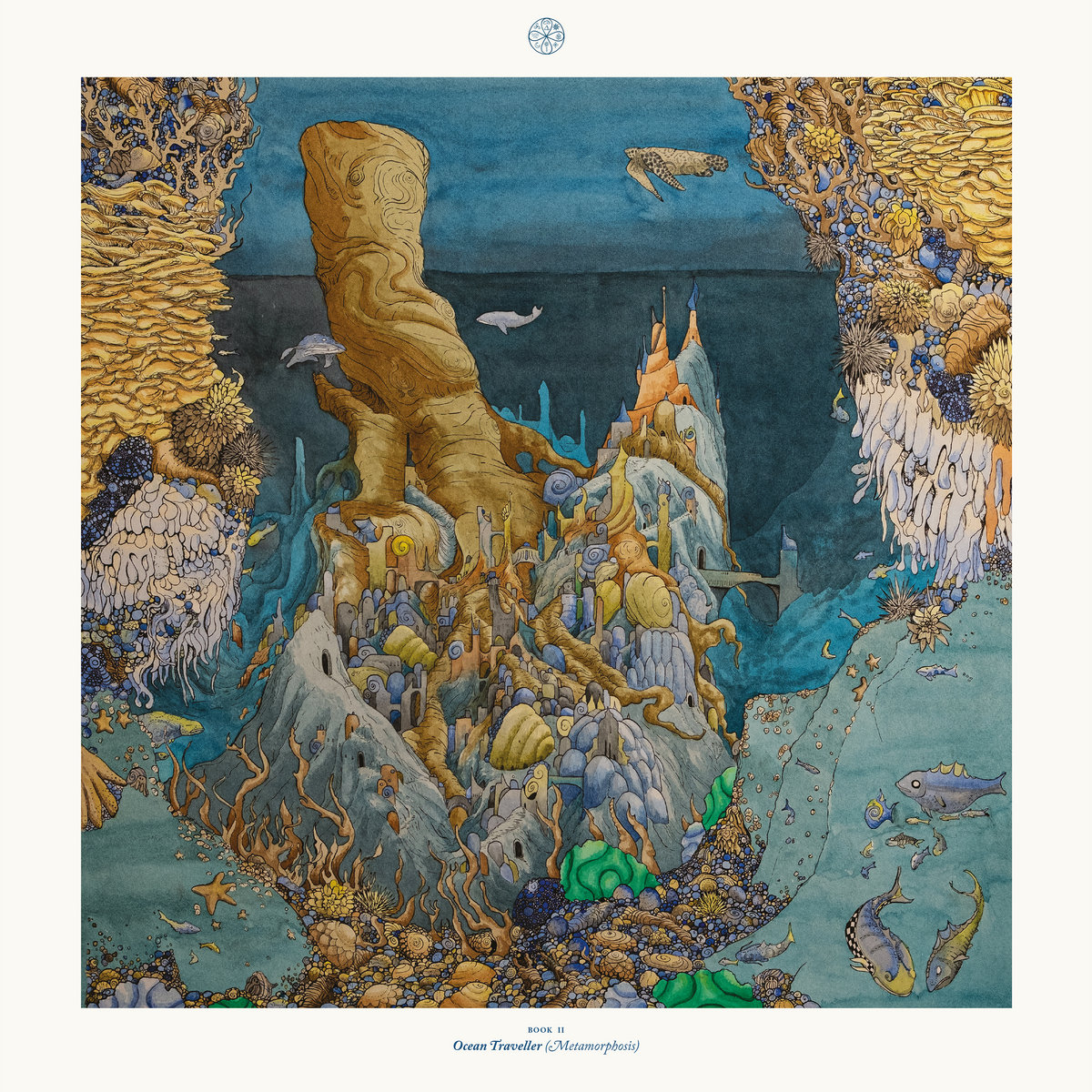
Band: The Chronicles of Father Robin | Album: The Songs & Tales of Airoea – Book II | Genre: Progressive rock | Year: 2023
From: Oslo, Norway | Label: Karisma Records
For fans of: Yes, Wobbler, Änglagård
I went over the three-decade background of this band in my review of Book 1, and I mentioned that I hoped the three planned installments would have distinct characters. Where Book 1 covered the lands of Airoea–hills, valleys, forests, and so on–Book 2 focuses on the waterways of this realm. There is a noticeable tonal and timbral difference between these two records, and I appreciate that effort. The songs here have a distinctly aquatic vibe.
“Over Westwinds” opens with an ethereal kyrie eleison sung over gentle acoustic guitar. This ritualistic intro feeds naturally into a calm, reserved verse. I like the way flute lilts in the background, and though not a ton happens in this song, it’s a promising starting point.
The soothing mood continues with the introduction of electronic bloops in the opening of “Orias: the Underwater City”. The lush keyboard tones that accompany the verse set this submarine scene very well. However, this song takes a while to really get going. Between the four-minute opening track and this song’s slow-moving build, Book 2 (which clocks in at under 40 minutes) feels like it spends nearly ten minutes introducing itself. Percussion doesn’t even enter until past this song’s halfway point. But when it does, it’s a quirky beat that sounds like the old, cheesy electronic percussion you’d hear on certain organs. It works well with the various retro keyboard sounds, and it reminds me a lot of Regal Worm’s last album.
The piano line which opens “Ocean Traveller” is fun and bouncy, and there’s a sense of both drama and whimsy as the song moves through some big-sounding instrumental passages. At points, there’s a pronounced waltz beat that lends this song’s moderate tempo a certain lightness. In the final two minutes, there are some weird and fun guitar lines that call to mind some of Beardfish’s best work.
“Lady of Waves” continues with the floating, placid nature of the album so far. Around halfway through, the band finally puts some muscle into their music. The unendingly calm nature of this album has been its biggest downside so far, so even the relatively brief interlude of bombast on this track is welcome. The hard-rocking section is revisited in the conclusion, and it’s the most exciting this album has been up to this point.
These relatively heavier tones continue on “Green Refreshments”. The pace is more deliberate and plodding, and the liberal application of Mellotron and flute in contrast to the guitar parts reminds me of Anekdoten. Some folk and jazz flavors show up here, and I really like the way flute is integrated with this song’s more aggressive stature. Jordsjø’s influence is pleasantly evident in the Nordic folk themes woven into this composition. Most of this band’s two albums (so far) have sounded primarily like Wobbler.
Book 2 ends on “The Grand Reef”, an upbeat and energetic cut with lots of organ, flute, and folk-inflected guitar. As such, I get pretty strong Jethro Tull vibes off of this cut. In particular, the opening reminds me of certain passages on Thick as a Brick. There’s a fun, Wakemanesque synth solo in the song’s middle, and the second half features a brooding, stormy buildup that I love. It’s a strong way to end the album.
The second of three planned albums from The Chronicles of Father Robin is something of a split decision. It’s more focused than Book 1, and I do appreciate (at least on a conceptual level) the album-spanning increase in intensity from track to track. However, Book 2 also takes its sweet time to get going, and getting through the first three songs on this album is a bit of a slog that often leaves me looking at my watch. Overall, I enjoy this record, and I’m very glad it’s distinct from Book 1. Book 1 is more consistent, but the high points are higher here. I’m eager to see what Book 3 winds up being like, when that comes out in February. Fingers crossed, it can thread the needle of focus and consistency.
Score: 78/100
 The Elite Extremophile
Been reading your site for a while now, and I like what and how you’re doing it. Been listening to this album, and I quite like it. You ding them for the slow pacing of the front half of the album, and I get that. But… I think it’s clear that this is old school, in the sense that it’s paced for vinyl. The mellower and the more upbeat correspond to sides A and B. It’s not unlike, say, what Bowie was doing on a couple of his Berlin albums. I dig it as a vinyl experience, although it may not translate to streaming or CD as well.
LikeLike
I agree with Thomas’s assessment here, but I just want to add something. I think maybe it’s best viewed not through the lens of “Prog rock album,” rather it’s more like an ancient epic poem akin to The Iliad/Odyssey/Beowulf/the Divine Comedy etc…the entire project is one cohesive tale, there is no end without the beginning. The ancient epic poem started out as oral tradition, composed and told by bards — it wasn’t written until much later. This is closer to the epic’s original medium, as it’s told/sung over the span of the entire 3 books. The sheer size of this tale is structured like the epic cycle. Not to mention, it’s engaging in world-building, and this is happening in the beginning of the album. Not to mention, the way this album builds is very reminiscent of how ancient people viewed the world, Father Robin progresses from earth in the first album, to water/sea, then to the air/sky. It mimics the hero’s journey. Father Robin starts on land, where everything is stable and there’s multiplicity of life, there’s stability rooted in matter. Meaning emerges from formless chaos and is ordered into earthly existence, but with the death of the fair maiden, we see multiplicity starting to lead to loss. At the end of Book 1, in Twilight Fields we hear them say “Chaos” — the land has come completely undone… and in Unicorn we see “Eleision is Ruined” — multiplicity has torn everything apart, leading to the beginning of Book 2, where Father Robin descends into underwater realms. Water is formless and chaotic, the first song Over Westwinds almost sounds like a funeral, Father Robin has descended into death (whether metaphorical (akin to exile), or not although the lyrics hint at death with “hours of divine sleep”), the boundaries of solid land are gone, and everything feels like a dream. The beginning of the album is reflecting this. Our hero has lost everything and is disoriented under the water, in song 2 it picks up as the hero descends further, until he encounters elder spirits/language of the first born. Ancient people would have understood this as an encounter with the logos that structures reality from chaos. It’s a moment of revelation in exile. Everything is stripped away, all of the multiplicity which Father Robin was forced to attend to/focus his attention on is now gone, and in the quiet depths of the ocean/exile/death he has a moment of revelation. Unity emerges from multiplicity, and the abyss yields its treasures. It’s meant to feel slow/endless in some sense, because the hero is in exile from his forest, lost all sense of meaning/boundaries/direction. But he discovered the logos hiding in the margins. The descent leads to resilience. (In Christian/Ancient Jewish traditions this is akin to the baptismal pattern — immersion yields the spirit’s descent) — we see this in Lady of Waves, the milkwhite laughing lady, seems to be Sophia-like wisdom/the spirit hovering over the waters. She bridges the abyss from the logos/elders to Father Robin, this isn’t dissolution, rather it’s reintegration of all the fragmentation of Father Robin into a cosmic pattern. We see the lyrics shift here from inward pointing/introspective to outward calling and revelation. Father Robin, looks up and in green refreshments and sees other worldly entities/angelic entities/the stranger and has glimpses of the heavens through the waters…the music picks up here because Father Robin is about to be reborn…it’s faster and chaotic like birth-pangs, he’s renewed with meaning, transformed, and reborn. The album deeply reflects the metamorphosis of liminal waters.
As far, as I’m concerned it’s pretty perfect and mimics the hero’s cycle/an epic poem. In book 3, we see the ascent of Father Robin into the heavens (resurrection/ascension), the hero’s cycle doesn’t stop at re-birth, but must return home “and become once again” as Father Robin says in the last song of the third book.
Honestly, while it harkens old prog rock (for good reason), I think this should be listened to (and reviewed) as you’re listening to an ancient epic sung by a bard. I think it is something missing from the modern world, and something maybe we don’t fully have categories to define it with. I think it’s a pretty incredible feat.
LikeLike