
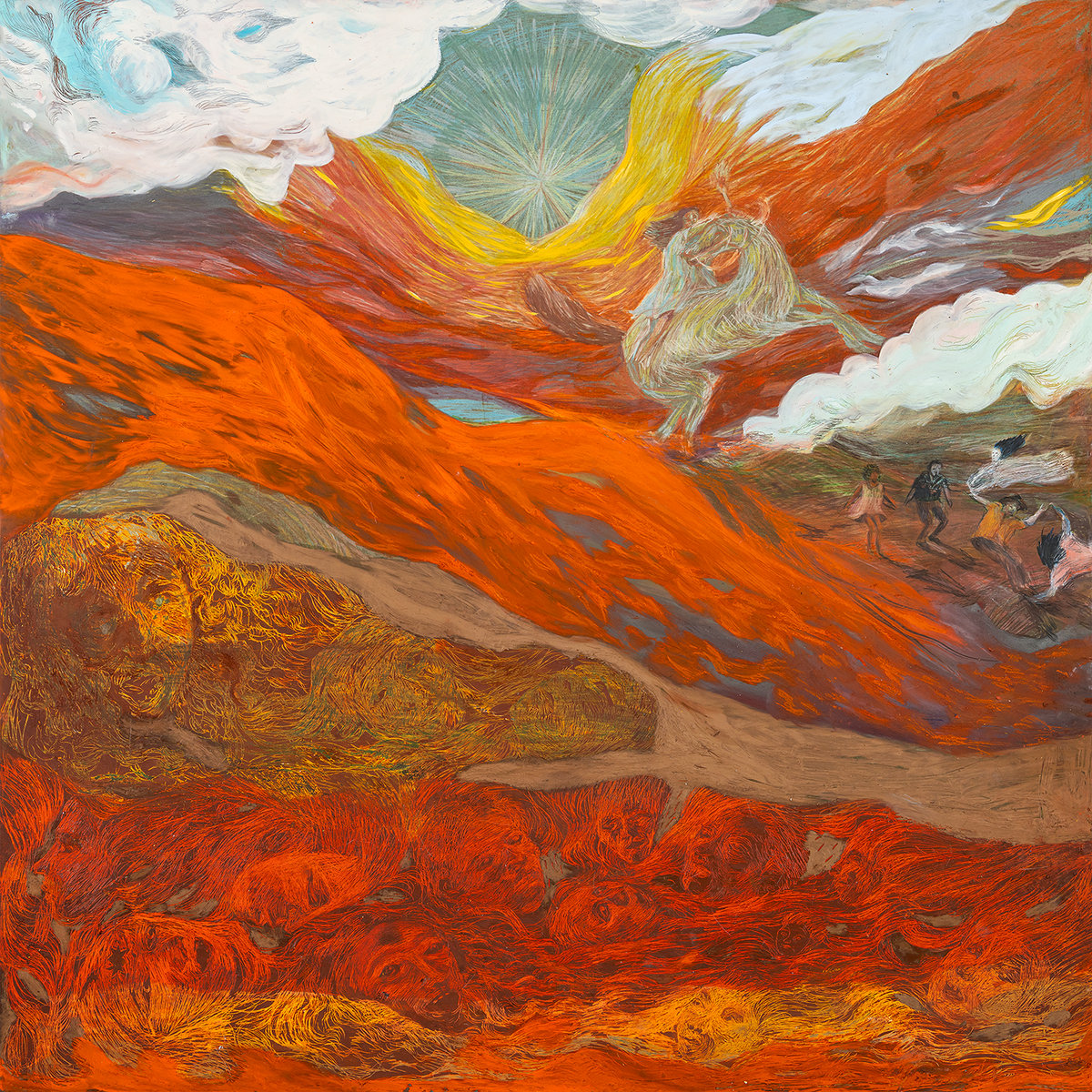
Band: Papangu | Album: Celestial | Genre: Progressive rock, Jazz-rock | Year: 2026
From: João Pessoa, Brazil | Label: Deck
For fans of: Genesis, Soft Machine, Gentle Giant, King Crimson
Brazilian prog quintet Papangu returns with their third LP, Celestial. This was likely my most-anticipated album of the year, given this group’s track record. Their 2021 debut, Holoceno, is, to date, the only album I’ve given a perfect score to upon release. That album is easily the best integration of zeuhl and metal I’ve heard, and even now it absolutely holds up after many, many listens.
Then in 2024, the band shifted their sound rather drastically on their sophomore LP Lampião Rei. With the expansion of the band to include keyboards and wind instruments, Papangu explored a jazzier direction. That jazziness continues here, with sounds from both the band’s native Brazil and the Canterbury scene playing prominent roles. Hints and dashes of their metal and zeuhl roots crop up throughout this album, but the sound is overall much closer to Lampião Rei than to the apocalyptic tones of Holoceno.
Overall, I enjoy Celestial a lot. Papangu demonstrates a fantastic ability to incorporate forró music from their native northeastern Brazil in a way that feels completely organic. This is especially prominent on “Bode Expiatório”, where triangle and flute work opposite some fantastically wonky synth tones, and on “Fechamento de Corpo”, where it marries with ethereal space rock.
But even more so than their incorporation of Brazilian music, the most dominant flavors here (outside progressive rock, obviously) are various strains of jazz. Every song on Celestial could be described as “jazzy,” but there is a lot of variation between cuts. Some moments are light and relaxed, like “Afirmação”, and others are tauter, such as “Iamanakaru”.
Keyboards dominate the sound palette of Celestial, which largely serves to underscore the band’s jazzy turn. Swirling organ, tinkling electric piano, and intergalactic synths all mingle and weave around each other to create lush soundscapes.
Just because Papangu has largely pivoted away from the sounds of Holoceno doesn’t mean that there are no commonalities between it and this album. I wouldn’t call any songs on this record “metal,” but a few have passages that flirt with being metallic. “Taxidermia” is the overall-heaviest song on the album, and “Calado (do Olho)” spotlights some tangled, zeuhlish riffage.
Zeuhl-inspired moments crop up elsewhere, too. “Celeste” features some moments that clearly draw from Magma, and the chanting on “Iamanakaru” wouldn’t be out of place on a Corima record.
Harsh vocals are used a handful of times throughout the album, to somewhat mixed results. The growled backing vocals on the opening “Mau-Olhado” come off as awkward in an otherwise-solid song. But their deployment in “Taxidermia” feels more effective.
Another ding against this album is that the guitars can feel pretty thin and unimpactful. This is not universal. There absolutely are moments where the guitars sound great, but on some tracks—especially the first two on the album—there is a lack of depth. Compare this to the keyboards, which consistently sound phenomenal.
I do need to compliment the way this album is put together. Each of the individual songs flow naturally, and they all feel the appropriate length. I don’t think Papangu has yet recorded a song that has felt overlong, which is a rare feat for a prog band on their third LP. And at a macro level, the record is very well-paced and feels satisfying.
Celestial makes sense for Papangu’s trajectory. They leaned hard into jazz and Brazilian music on their last album, and they’ve doubled down here. Everything is very smartly assembled, and the band members demonstrate keen instrumental skills. I am glad they’re forging their own path and following their artistic hearts. That said, I do miss their heavier sound, as well as the former prominence of zeuhl. But with this band, you never quite know what you’re going to get next.
Score: 86/100


The Band is Papangu and not Panagu! 😉Amour, Joie, Paix !François Bérubé
LikeLike
Thanks for the catch!
LikeLike