
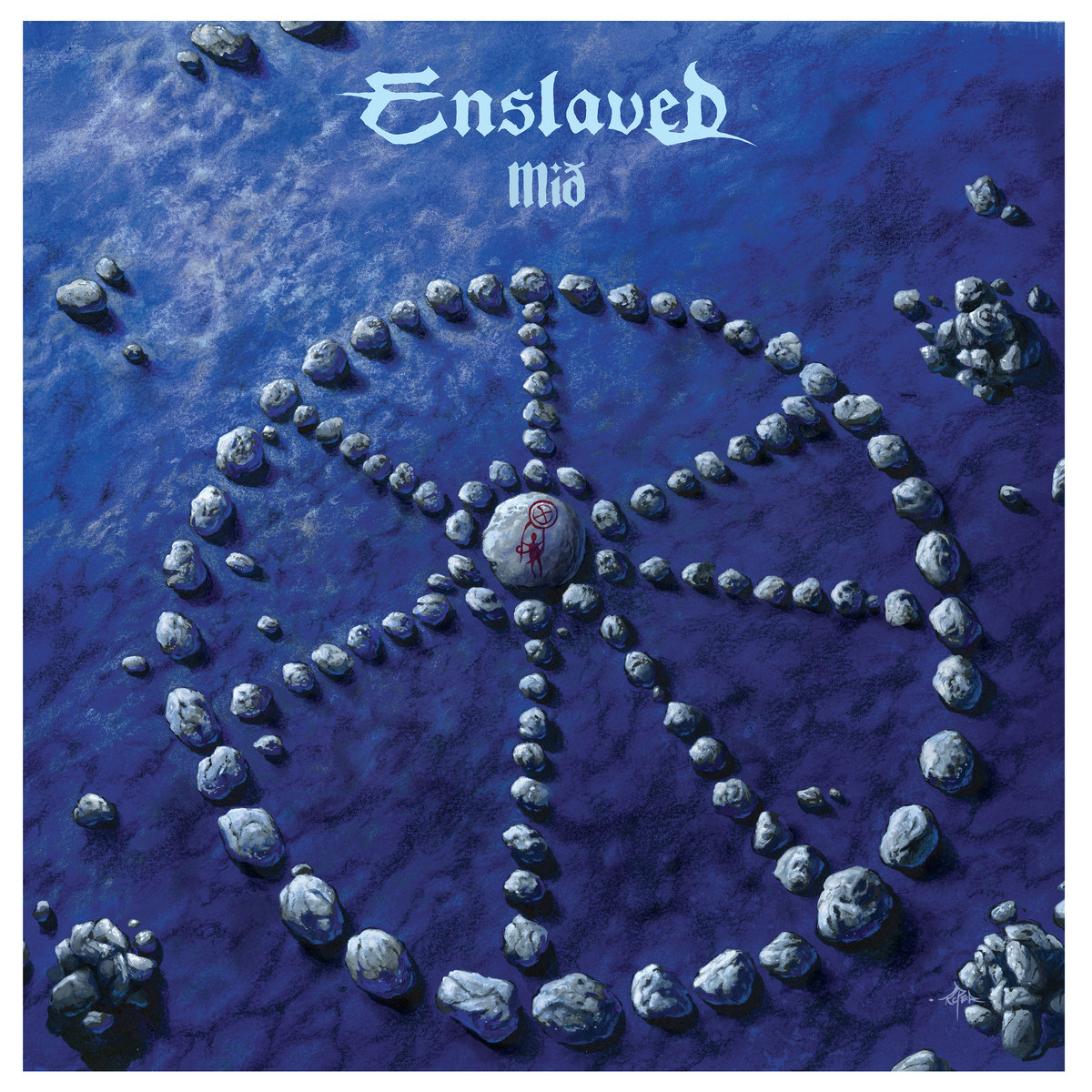
Band: Enslaved | Album: Mið | Genre: Progressive metal, Black metal | Year: 2026
From: Haugesund, Norway | Label: Nuclear Blast Records
Progressive black metal stalwarts Enslaved have returned with their 17th full-length album, Mið, the Old Norse word for “middle” or “center.” (For my readers unfamiliar with the character ð, it’s pronounced like the “th” in “this.”) Considering my thoughts on their last couple albums, if Enslaved failed to deliver here, they’d be setting themselves up for an easy joke about this being “pretty mið.” However, the fact that I’m bothering to write a full-length review ought to clue you in that this record is either pretty good or truly abysmal. And while Enslaved has certainly put out their fair share of albums that haven’t resonated with me, they’ve never put out anything awful.
Fun fact: It was an exceptionally inept review of Enslaved’s 2015 album In Times that made me start seriously considering turning my year-end music blurbs into a blog. I was trying to find a review of that record, and I remember I ran across one that used a bunch of flowery language but didn’t actually discuss what the music sounded like. And yes, Enslaved certainly has a sound that they stick to, but I’m of the mind that any decent music review should give you at least a vague idea of what you’re in for, sonically. But that review (which I cannot seem to find now) has stuck with me for how ineffective it was.
But back to the topic at hand, Enslaved has had a bit of a mixed record over their last several releases. 2012’s RIITIIR was the album that really got me into this band, and I love it. In Times didn’t really click with me, but I quite liked 2017’s E. And then their last two releases–2020’s Utgard and 2023’s Heimdal–didn’t really resonate. However, there was a single released over the summer–which I’ll discuss below–which got me very excited for a new album from these guys. And I’m happy to say that my excitement and hope for this record were well-placed.
After a brief atmospheric intro, the first proper song on the album is “I Am Ice”, which features Sami yoik singer Johan Sara Jr. Right from this get-go, his howls and throat-singing add a unique mood to this song. The feel is ancient and ritualistic. Contrasting this, in the song’s midsection, there’s a glimmering, futuristic synth solo. Though not as structurally complex as some of their other works, this song still shows Enslaved can make some effective and creative compositional choices.
“Solar Will” features a strong and surprisingly catchy melody at moments, but elsewhere the music can be more abstract. The clean backing vocals are an especially effective inclusion. The guitar solo near the song’s end is almost Gilmourian, which is a fun twist in a genre as frenetic as black metal. In contrast, “Mountain” has a quiet and stripped-back opening. Scratchy clean guitar and soulful vocals set a contemplative scene. About halfway through, though, the song grows darker, with an off-kilter, slinking guitar riff leading into a passage that draws very heavily from doom metal.
“Spirit Helper”, the lead single, is what initially got me excited about this release. It prominently features Kevin Kicking Woman, a Blackfoot elder, whom bandleader Ivar Bjørnson met through his participation at the Fire in the Mountains festival hosted on the Blackfeet Nation. Kicking Woman’s vocals are a chant traditionally performed in the morning, and the song’s gradual build stands in for the rising sun. The riffs on this song are impressionistic, drawing from post-rock and post-metal, and traditional percussion adds more to the setting as the song progresses.
Classical-influenced piano and lush synth pads open “Parting”, the longest song on the album. When the verse gets going, it’s Enslaved’s classic melodic black metal with clean vocals. Post-metal influences again creep in here, with the guitars and synths blending into a hypnotic rhythm and wall of sound.
“Tales of Trees” is more immediate than the preceding cut, with guitar and organ swirling in a powerful hurricane. Mellotron strings add a sense of lightness and hope during the chorus, and parts of those passages remind me a lot of classic late ’60s psychedelic rock. It’s an unexpected influence, but it’s a really fun surprise to hear. Acoustic guitar also adds some interesting folky texture on top of the churning metallic riffs.
Mið closes on “I Miðju”. It’s not a bad song, but it’s probably the weakest on the album. This feels the most like baseline Enslaved with nothing particularly distinctive to differentiate it from many other songs in their oeuvre. It’s mid-tempo melodic black metal with some nice keyboard flourishes.
Overall, Mið is a solid record. It displays a certain vital energy that I didn’t quite get with Utgard or Heimdal, and it includes some interesting influences. Aside from the obvious guest musicians bringing their own native styles along, dashes of post-metal and folk help to add some sonic diversity.
Score: 84/100

